IPFN Speaks out on Mukumlung Issue; calls for restraint and solution:
No cable car is the best policy for now!

Kathmandu, February 6-
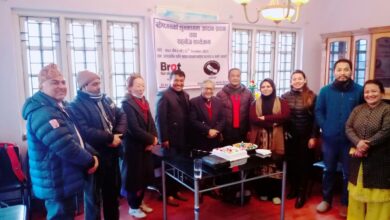
Interfaith Peace Federation-Nepal (IPFN) has called on all stakeholders for restraint and solution, not conflict and strife regarding the historic religious site of Mukumlng, otherwise know as Pathibhara.
As a representative forum of all the religious communities in Nepal, IPFN has been voicing strong opinions on perceived injustice and encroachments on religious beliefs and practices.
The Press Release issued today reads:
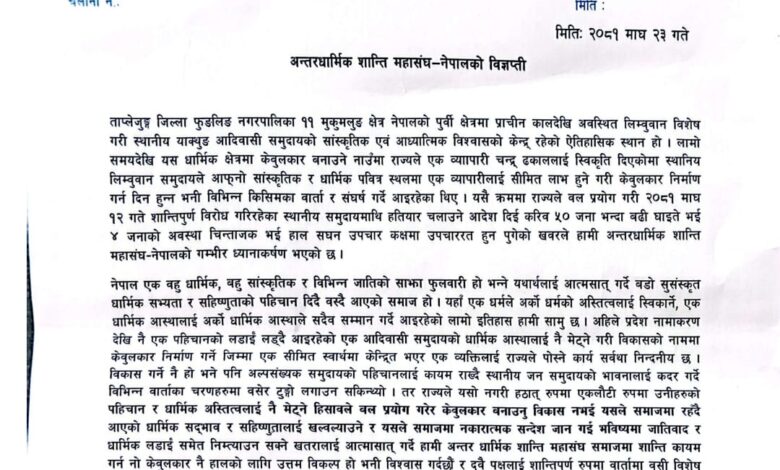
Mukumlung area of Taplejung district, Phungling Municipality 11 in Limbuwan, located in the eastern region of Nepal, is a historical place that has been the center of cultural and spiritual beliefs of the local Yakthung indigenous community since ancient times. For a long time, the state had given approval to a businessman Chandra Dhakal to build a cable car in this religious area, and the local Limbuwan community had been holding various talks and struggles to prevent a businessman from building a cable car in their cultural and religious sacred place for limited benefits. In the meantime, the state used force and ordered the use of weapons on the local community who were peacefully protesting on 12 Magh 2081, injuring more than 50 people. The news that the condition of 4 people is worryingly serious and they are currently receiving treatment in the intensive care unit has drawn the serious attention of the Interfaith Peace Federation-Nepal.
Nepal is a society that has been in existence by recognizing the reality that it is a multi-religious, multi-cultural and multi-ethnic society and has been developing a highly cultured religious civilization and a sense of tolerance. Here, we have a long history of one religion accepting the existence of another religion, and one religious belief being respected by another. Now, since the naming of the province, the responsibility of erasing the religious beliefs of an indigenous community that has been fighting for an identity, and the state focusing on a limited interest to build a single person in the name of development, is completely condemnable. Even if it is to develop, it could have been settled by maintaining the identity of the minority community and respecting the feelings of the local people through various stages of negotiations. However, the state, without doing so, unilaterally and unilaterally using force to erase their identity and religious existence, will not develop, and this will disrupt the religious harmony and tolerance that has been existing in the society, and this will send a negative message to the society and may even lead to racism and religious wars in the future. We, the Interfaith Peace Federation, believe that no-cable car is the best option for the time being to maintain peace in the society. We also urge both sides to peacefully negotiate, especially the state to find a better option without disturbing the religious beliefs of the indigenous community. We also sincerely appeal to the entire civil society, political parties, various religious communities and relevant stakeholders to find a right solution without resorting to further confrontation in this historical religious Mukumlung region. 
Rambhakta Kurumbang Dr. Mahendra Bhattarai
Chairman General Secretary
Interfaith Peace Federation-Nepal